

XR Exec Talks with BadVR

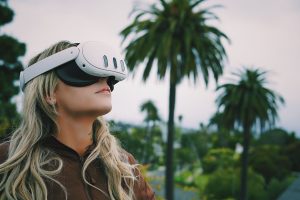 Name: Suzanne Borders
Title: CEO and Co-Founder
Company: BadVR
LAVNCH [CODE]: We know your title, but what do you actually do at BadVR?
SUZANNE BORDERS: I do a little bit of it all, to be honest! The title ‘CEO’ at a startup is really a generalist’s dream—I do everything from operations, to leadership, to fundraising, to designing interfaces, to booking hotels, to ordering t-shirts, all of it. I try my best to motivate people and inspire them to do great work, but this has been very difficult for me, as I’m an introvert and I’ve never in my life needed stuff like that myself from an employer and I’ve always thought it was so cringey and lame. However, I am learning that great, wonderful fact of life: Everyone is different and what works for me, doesn’t work for everyone else and vice versa.
It’s been very eye opening, to say the least. Leadership has really pushed me to grow and expand my human skills, in all the best ways. Most importantly, as the CEO, as the company leader, I create and nurture the company’s vision, the long-term goals it’s trying to accomplish. I spend every day ensuring that all of the company’s actions strengthen and galvanize all of us towards realizing this vision—as well as help us get us one step closer to achieving our mission of democratizing insight!
LAVNCH [CODE]: In your opinion, what is the most exciting thing about extended reality?
SB: I think extended reality (XR) is exciting because it can be used in so many ways! There are literally hundreds—nay, thousands—of unique, ways in which extended reality can be used to help improve businesses workflows, customers, you name it. And that potential is super exciting! Plus, extended reality reminds me of the holodeck, but instead of being science fiction, it’s science reality. XR is like a little slice of the future, made manifest in the present. It’s the germ of an entirely new existence. Who wouldn’t be excited about that!?
LAVNCH [CODE]: Where do you see the XR market heading in the next year?
SB: I know a lot of people really want XR to start to make real headway into the commercial market, but I am convinced that an XR commercial market is still many years down the line. I think within the next year, we are going to see incremental improvements to XR hardware and XR software—lighter, more powerful mobile headsets, more targeted, focused, useful apps with better UX/UI design. We’ll also continue to see the adoption of B2B virtual/augmented reality (VR/AR) solutions in defense, utility, heavy industry, and large enterprise sectors.
I believe use cases for XR will continue to refine, to become more specific and specialized, and that we’ll maybe unlock a couple newer applications of the technology that was not previously known. It can be frustrating when things don’t explode overnight, however, if you look at life changing technology (such as the Internet), it also takes a long time to trickle down to consumers. If I’ve learned anything in life, it’s that there are no shortcuts. The more powerful and game-changing the technology, the longer it takes for humans to understand and adopt. So, I’m not worried.
I still passionately believe in the power of XR, and I think the fact that so called ‘normal people’ still struggle to wrap their heads around it is proof positive and a testament to its power, not proof of the lack thereof. When consumers finally do adopt XR in full, it will likely become a foundational technology. What more could you really want?
LAVNCH [CODE]: What new XR products and services are on the horizon for BadVR?
SB: BadVR is well known for our product SeeSignal, an app that uses XR technology to help people literally see the RF spectrum around them. It gives human x-ray vision, allowing people to not only see their networks in their entirety for the first time, but also empowering them to monitor and respond to these networks (and network threats) in real-time. This SeeSignal product has gone viral a couple times on Twitter/X, but what people may not know is that we are in the process of porting SeeSignal to AR-enabled Android phones and tablets.—meaning SeeSIgnal will soon be available to download from the app store straight onto your mobile phone (as well as headset). I want to give a big, awesome shout-out to Telia, a Norweigan telecom, who has graciously helped support the development of SeeSignal mobile, and who has continued to serve as our partner and champion. We have some fascinating useage data coming out of the Telia testing sessions too—we are very excited to share this with everyone soon. We are so honored to partner with Telia to bring SeeSignal mobile to life.
In addition to Android versions of the SeeSignal app, BadVR is also working on an iOS app as well, which would include support for SeeSignal on Apple’s Vision Pro. SeeSignal’s Android debut will be coming soon; the Apple equivalent (including Vision Pro Support) is on the horizon too—or sooner, if Apple would like to work with us and offer additional access and support (hint, hint)!
As for our other product—AROC, or Augmented Reality Operations Center—we have a very exciting product release coming up for this product as well. We are partnering with Meta to bring our public safety immersive AROC training platform to public safety organizations around the country, via Meta’s new B2B app store and app distribution platform.
We have so many exciting new products, partners, and platforms, and it’s hard to keep track of it all. However, rest assured, 2024 and 2025 will be big years for BadVR and we are excited to continue to expand our company and product offerings!
LAVNCH [CODE]: Anything else you’d like to add?
SB: I think the convergence of AI + XR + 5G is the real game changer! As with all things in life, nothing happens in a vacuum, and it’s never one type or piece of technology that changes the world, but rather a group of technologies, working in concert with each other, that proves to truly alter human life (hopefully for the better). Think about how smart phones wouldn’t be nearly as useful if cellular data plans didn’t exist. Or how diminished smartphones value would be if they didn’t have navigation apps, like Google maps. What ultimately matters isn’t the raw power or innovation of any one technology; what matters is how multiple technologies come together to help change people’s daily lives.
There’s certainly a small segment of the population that cares a lot about processing speed or FPS (frames per second), but let’s face it, most technology users don’t care about these things. They barely even care about the price/cost of technology (controversial opinion, I know, but you cannot convince me people are especially price sensitive when they regularly pay $1K+ for their iPhones and MacBooks….but I digress). What most technology users and adopters care about is “does this technology make my life better? Easier? Less stressful?” And until any technology—XR included—can solidly answer that question, it will languish in adoption. That’s why I think the combination of AI and 5G with XR will really be the thing that cracks the code for wide-scale commercial adoption of XR devices. As software developers, the people who make the apps for these devices, we often forget that the first question we should be asking ourselves is “What problem does this app solve for my parents?” Because if you can answer that question in a real way, you’ll never go wrong.
LEARN MORE

Disguise and Nikon Bring Immersive Action to CES 2025
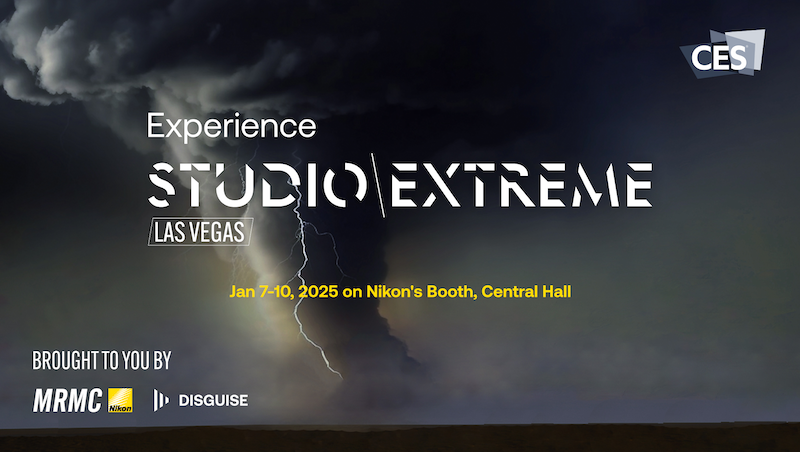
Disguise has partnered with Nikon to unveil a new CES activation that focuses on a can easily create in a turnkey virtual production studio.
Check out ISE 2025’s Educational Offerings

ISE 2025 has unveiled its educational offerings and is introducing flexible ticketing options, including the new Content Day Pass.
Top Tech Gifts for 2024

The community gave their input on the top tech gifts for 2024—and who better to make a tech gift guide than the pros who use tech every day?
