


Canon Developing Ultra-High-Sensitivity ILC Equipped With SPAD Sensor

Canon U.S.A.. is developing what the company claims is the “world’s first” ultra-high-sensitivity interchangeable-lens camera (ILC) equipped with a 1-in. Single Photon Avalanche Diode (SPAD) sensor featuring the “world’s highest” pixel count of 3.2 megapixels.
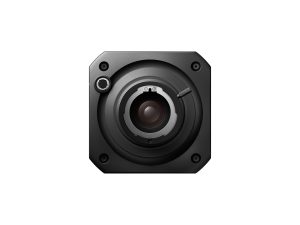
Canon MS-500 with SPAD Sensor
The camera, MS-500, leverages special characteristics of SPAD sensors to achieve low-light performance while also utilizing broadcast lenses (sold separately) that feature high performance at telephoto-range focal lengths. Because of this, the company believes the MS-500 camera is expected to be ideal for such applications as high-precision monitoring.
There is a growing need for high-precision monitoring systems in such environments as national borders, seaports, airports, train stations, power plants, and other key infrastructure facilities, in order to quickly identify targets even under adverse conditions including darkness in which human eyes cannot see, and from long distances.
The currently in-development MS-500 camera is equipped with a 1-in. SPAD sensor that helps reduce noise, making it possible to produce clear, full-color HD imaging even in extreme low-light environments. When paired with Canon’s range of broadcast lenses, the camera is capable of accurately capturing subjects with precision in extreme low-light environments, even from great distances. For example, the camera may be used for nighttime monitoring of seaports, thanks to its ability to spot vessels that are several miles away, thus enabling identification and high-precision monitoring of vessels in or around the seaport.
With CMOS sensors, which are commonly used in conventional modern digital cameras, each pixel measures the amount of light that reaches the pixel within a given time. However, the readout of the accumulated electronic charge contains electronic noise, which may diminish image quality, due to the process by which accumulated light is measured. This could lead to degradation of the resulting image, particularly when used in low-light environments. SPAD sensors employ a technology known as “photon counting” in which light particles (photons) that enter each individual pixel are counted. When even a single photon enters a pixel it is instantly amplified approximately one million times and output as an electrical signal. Every single one of these photons can be digitally counted, thus making possible zero-noise during signal readouts—a key advantage of SPAD sensors. Because of this technological advantage, the MS-500 camera will be able to operate even under nighttime environments with no ambient starlight, and will also be capable of accurately detecting subjects with minimal illumination and capture clear color images, according to the company.
The MS-500 camera employs the bayonet lens mount (based on BTA S-1005B standards) which is widely used in the broadcast lens industry. This enables the camera to be used with Canon’s range of broadcast lenses. As a result, the camera will be able to recognize and capture subjects that are several miles away.
Going forward, Canon says it will “continue to pursue R&D and work to create products that could surpass the ability of the human eye and contribute to the safety and security of society.”
Canon plans to begin selling the MS-500 in 2023. It will be displayed as a reference exhibit in Booth C3825 during the 2023 NAB Show.
Click here to stay up-to-date with the latest show news and visit our NAB Show 2023 hub.
LEARN MORE
Registration Now Open for the 2024 NAB Show New York

Registration is now open for the 2024 NAB Show New York, held October 9-10 at the Javits Center in Manhattan.
Canon Demos CJ27ex7.3B Portable Lens at NAB Show 2024

Canon demonstrated its new CJ27ex7.3B Portable Lens at the 2024 NAB Show in the Las Vegas Convention Center.

All Things NAB Show 2024

The 2024 NAB Show will be held in Las Vegas, NV next week. Here's everything you need to know before you go!
