


The Latest Technologies for Virtual Production


Virtual production is reshaping filmmaking and content creation. This new approach integrates real-time technology with traditional techniques, offering unprecedented creativity, efficiency, and realism. By blending physical and digital worlds, filmmakers can visualize and capture immersive environments in ways previously unimaginable. Virtual production technologies, from LED displays to advanced processors and software, are driving a paradigm shift in the entertainment industry. In this article, we’ll explore virtual production and the contributions of companies shaping its evolution.
LED technology is rapidly innovating virtual production, providing opportunities for immersive storytelling. VFX supervisor Brian Meanley of Whiskytree, a visual effects company, highlighted the integration of LED displays in its virtual production pipeline, noting advantages over traditional green screens. While green screens offer easier matte generation, Meanley says LED volumes facilitate seamless integration of actors into backgrounds with subtle lighting effects, simplifying tasks like spill suppression and character edge integration.
According to Alex Zou, general manager of XR and virtual production at Planar, LED displays seamlessly integrate into virtual production workflows, providing high-resolution, immersive backdrops for real-time rendering of photorealistic virtual environments. When combined, these displays create expansive volumes that accurately respond to camera movements, enhancing the overall immersive experience.
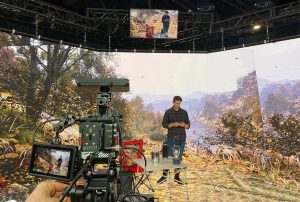
According to the company, the Planar Venue Pro VX Series features enhanced capabilities to deliver durability, next-level deployment versatility, and superior visual performance. This includes improved contrast, lower scan ratio, and higher frame rates for unparalleled in-camera and on-camera performance.
Zou also laid out some ongoing advancements in LED display technology shaping virtual production and extended reality, such as finer pixel pitches that enable the creation of lifelike content, allowing talent and cameras to be closer to video walls without visible pixel outlines. There have also been improvements in scan and refresh rates that reduce moire and on-camera artifacts, contributing to smoother motion and enhanced visual fidelity. Additionally, enhancements in color management and wider color gamuts have improved compatibility with camera systems, ensuring accurate rendering of skin tones and overall color fidelity.
Beyond resolution, Zou highlighted improvements in the physical design of LED video walls, including lightweight carbon fiber construction and curved capabilities, simplifying setup and enhancing flexibility. Adoption of SMPTE ST 2110 facilitates the integration of video walls into broadcast and live production IP workflows, enabling more scalable and flexible system architectures. Moreover, the use of multi-primary pixel packages expands the color gamut and improves color reproduction accuracy, especially when combined with full-spectrum lighting. Zou emphasizes the importance of LED processors and rendering engines in handling realistic visuals, enhancing creative possibilities in virtual production.
“LED video walls are often paired with camera tracking systems, allowing a virtual background to respond accurately to camera movements and maintain the illusion of a continuous 3D space,” he said.
Freelance engine and server programmer Amanda Facemire, highlighted the integration of LED-based workflows, such as In Camera VFX (ICVFX), that are revolutionizing the industry by enabling real-time rendering of virtual worlds in software like Unreal Engine. She emphasizes the role of AI content and tools in driving efficiency and creativity in the future.
“I’m sure we’ll start seeing more AI-generated content, or at least AI-powered tools for preparing content,” she said. “For example, depth maps, segmentation, and inpainting are all relevant t0 prepping content for 2.5D, and there are several AI programs that have gotten quite good at generating those. It can be a relatively automated process now.”
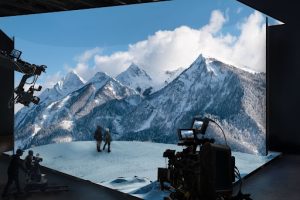
LG Studio Series dvLED, a new family of giant-screen displays, offer production studios, broadcasters, and corporate marketing departments opportunities to create professional-grade content using life-sized virtual production stages for on-camera color and clarity.
Tom Bingham of LG says LG’s Studio Series dvLED displays, equipped with genlock technology and brightness capabilities up to 1,500 nits, offer life-sized virtual production stages for on-camera color and clarity. According to Bingham, these displays eliminate the need for traditional green screens, providing realistic scenery for hosts or on-screen talent to interact with.
Similarly, Zou says Planar’s displays are equipped with features tailored to address the unique challenges of virtual production, such as durability, deployment versatility, and superior visual performance.
Adam Callaway, global lead for virtual production and broadcast at Brompton Technology, shed light on the pivotal role of processors in virtual production workflows. According to Callaway, LED processing is crucial for receiving and displaying video signals on LED panels, ensuring faithful reproduction of content while offering flexibility in settings. Brompton’s Tessera LED processors boast features like ShutterSync, enabling precise timing of LED refresh rates to match camera sensor exposure times, and Extended Bit Depth, which enhances dynamic range, which is particularly beneficial for night scenes and HDR content.
Callaway emphasized how Brompton processors optimize performance and streamline processes for filmmakers and content creators in virtual environments. Leveraging distributed processing and Frame Remapping for multi-camera workflows, he says Brompton maximizes efficiency, allowing for simultaneous display of different images or locations on LED panels, reducing set time and enhancing flexibility in shot composition. Recent advancements like the Tessera v3.5 release introduce features like Frame Store and TrueLight, enabling easier content testing and improving color accuracy for lifelike visuals.
Furthermore, Callaway highlighted Brompton’s collaboration with other technology providers in the AV industry to ensure seamless compatibility and interoperability with their products. By working closely with manufacturers and innovators, Brompton conducts testing and develops API integrations to address potential issues beforehand, fostering confidence in the workflows deployed by users and ultimately contributing to successful outcomes in virtual production endeavors.
Chaos’ approach to virtual production is characterized by their innovative technologies and commitment to simplifying workflows. Vice president of product management Phil Miller says the company first ventured into virtual production in 2015 with Construct, a project integrating real-time ray tracing into Autodesk’s MotionBuilder for realistic rendering of CG characters.
Project Arena, the company’s latest endeavor, offers a streamlined alternative to traditional game engines by eliminating much of the prep work typically required for scenes, allowing artists to use familiar tools like Maya or Houdini without special considerations. Addressing challenges such as asset preparation and maintaining film production standards, Miller says Project Arena enables seamless collaboration from pre-production to post-production, ensuring continuity across different stages of production. Chaos collaborates with industry leaders and listens to feedback from virtual production practitioners to enhance Project Arena’s stability and usability, with ongoing developments focusing on more convenient deployment and workflow optimization. With successful implementations underway and plans for further integration and refinement, Miller says Chaos aims to continue advancing virtual production technology to meet the evolving needs of filmmakers and content creators.
Virtual production stands at the forefront of a transformative era in filmmaking and content creation. Through the integration of real-time technology with traditional techniques, this approach offers avenues for creativity, efficiency, and realism. Advancements in LED display technology—exemplified by companies like Planar, LG, and Brompton Technology—are shaping the evolution of virtual production, providing high-resolution, immersive backdrops and cutting-edge LED processors to optimize performance and streamline workflows. Moreover, collaborative efforts within the industry, such as Chaos’ Project Arena, underscore a commitment to simplifying processes and enhancing usability for filmmakers and content creators. As virtual production evolves, it will continue to revolutionize storytelling and visual experiences.
LEARN MORE

Disguise and Nikon Bring Immersive Action to CES 2025
Disguise has partnered with Nikon to unveil a new CES activation that focuses on a can easily create in a turnkey virtual production studio.
Check out ISE 2025’s Educational Offerings

ISE 2025 has unveiled its educational offerings and is introducing flexible ticketing options, including the new Content Day Pass.

Top Tech Gifts for 2024

The community gave their input on the top tech gifts for 2024—and who better to make a tech gift guide than the pros who use tech every day?
